



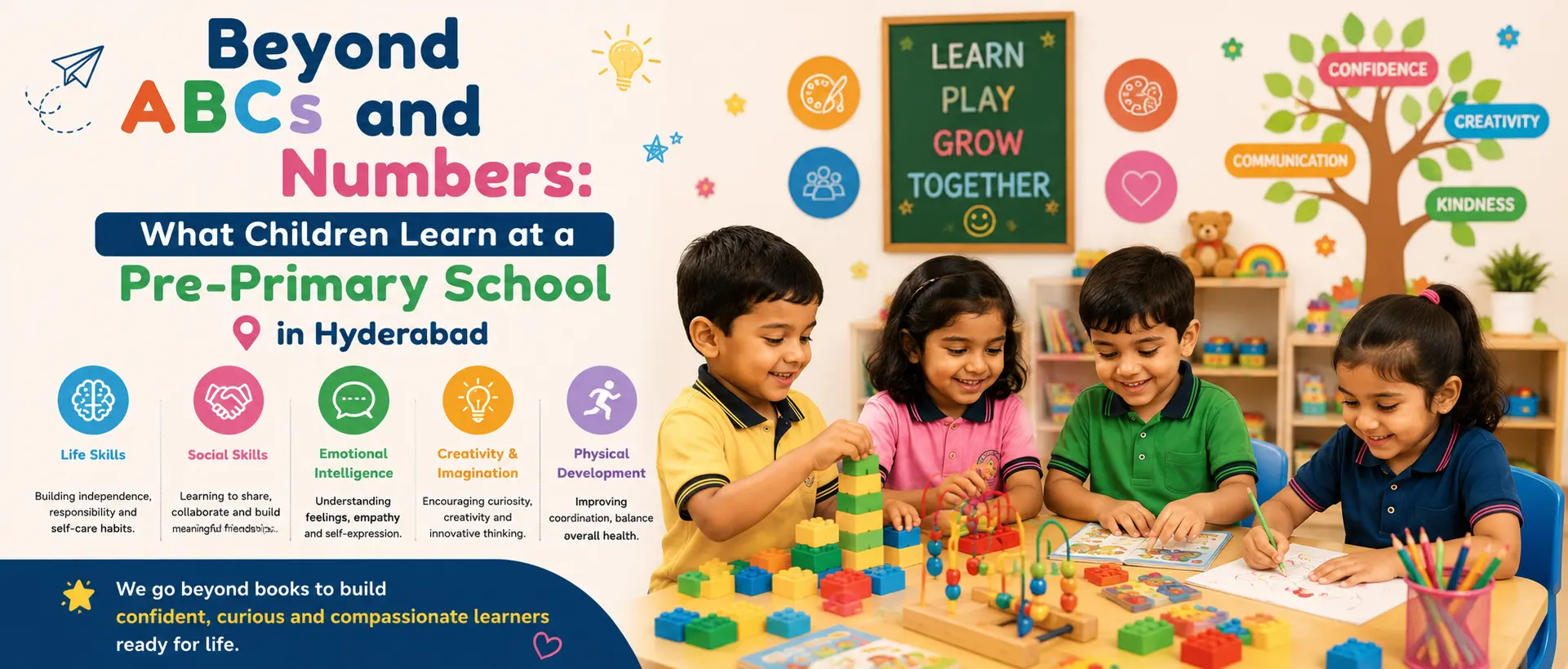
Beyond ABCs and Numbers: What Children Learn at a Pre-Primary School in Hyderabad
When thinking about preschool, parents are likely to consider things such as alphabets, numbers, colours, shapes, and vocabulary. It is true that these are elements of early learning, but preschool learning entails much more than worksheets or learning the alphabet.
A pre-primary school in Hyderabad offers a lot to children. The children at good pre-schools learn how the world works and interact with others while gaining their independence.
At Kiddles Academy, early learning revolves around actual experiences. Children learn by interacting with other children, sharing stories, playing games, dancing, and doing various activities in the classroom.
Learning to Speak, Listen, and Express Ideas
A little one can possess several words and still be in the process of figuring out how to use them correctly in conversation. Pre-school plays a big role in providing children with opportunities.
In the course of storytelling by a teacher, the teacher can inquire, “What do you think will happen next?” This allows a child to say what they saw or create a new ending.
Thus, one can say that although a conversation might look simple, the kid still gets to practise vocabulary, listening, imaginative thinking and speaking skills.
Learning How to Be With Others
For many little kids, making friends can be a completely new experience. They slowly realize that being part of a classroom means sharing a space, supplies, and the teacher’s attention.
For example, a teacher can assist two children who are trying to grab the same crayons and teach them to take turns or share.
There are many lessons that kids learn from these everyday experiences:
- Taking turns;
- Sharing;
- Listening to others;
- Communicating feelings;
- Resolving simple conflicts;
All these are social skills which are as important as some first academic skills.
Developing Independence One Small Step at a Time
Independence emerges from the small set of daily responsibilities.
For example, a child might learn how to keep their belongings in the right place, plan their day, clean up the toys after playing, and carry out some classroom routines.
It may not seem like much work for adults, but for a child, it is a good form of practice for independence.
Good pre-primary schooling in Hyderabad can help children do all of this with the right guidance.
Creativity Is Not Just About Drawing
When children take a paintbrush and accidentally end up with an unexpected result, it may not always be called a mistake. It may actually indicate that the children are experimenting.
Art and crafts help children explore colors, textures, shapes, and materials. Activities like music, dancing, drama, and storytelling provide more chances to express themselves.
A cardboard box can be anything in children's play – a car, a house, a shop, and even a spaceship.
There need not be one “correct” outcome. The creative process is already part of the learning process.
Learning Through Questions and Curiosity
Small kids are inborn questioners. Curiosity makes them seek information.
“Why is the sky blue?”
“Where ants go?”
“Why is this leaf different?”
What is better than relying on children’s answers? Let’s use their questions as a launch for studying.
For example, taking a nature walk can launch a little inquiry. Kids can collect leaves, watch insects, compare textures, and discuss the beauty that surrounds them.
It helps them learn to observe, analyze, compare, and ask even more questions.
Developing Physical Skills Through Play
One of the important forms of movement that provides opportunities to develop the body is running, jumping, climbing, balancing, cutting and coloring, building and turning pages as well.
Outdoors activities involve development of movement coordination while playing with scissors, coloring, paper folding, and simple crafts provide the opportunity to develop fine motor skills.
All these abilities help children in their future activities.
Understanding Feelings and Building Confidence
Another aspect of early education that is important to consider is emotional growth.
A child might be happy one day, but sad the next day. They might think about their family when climbing a mountain or feel proud when doing something by themselves.
A good classroom allows children to express these feelings and emotions.
When a child completes a puzzle after three tries, he is not only solving the puzzle but also learning how to be persistent and gaining self-confidence.
Learning Through Everyday Experiences
Among many important teaching episodes, some don't seem to resemble traditional lessons at all.
- During a snack break, children can learn about routines.
- Cleaning teaches responsibility.
- Role play teaches communication.
- Group games teach cooperation.
- Stories teach vocabulary and emotions.
- Outdoor walks teach observation skills.
This is why early childhood education cannot be assessed just by the number of letters or digits learned.
How Kiddles Academy Approaches Early Learning
Children at Kiddles Academy are encouraged to acquire knowledge by participating in age-appropriate activities. The objective is to create a friendly atmosphere in which children could have fun and explore, express their thoughts, and acquire necessary skills in a natural way.
Kiddles Academy offers not only age-appropriate experiences for toddlers but also allows youngsters to tell stories, draw pictures, act, learn about the surrounding world, and take part in interactive classes.
The goal is simple: children should learn not only to know more but to develop self-confidence in doing things, including communicating, thinking, and creating.
The Real Learning Behind the ABCs
The alphabet is an essential concept in beginning education, but this is only a tiny part of the whole process.
What they really aim for is to help the child grow up as a curious personality who has good communication skills, interacts well with other people, takes small responsibilities, and faces different cases confidently.
An effective pre-primary school in Hyderabad is not just the place where the child gets prepared to move to the next educational stage. It is a place that creates all sorts of useful habits and develops the skills that will last many years to come.
At Kiddles Academy, they aim at making every game, story, and conversation a vital element of this process as well.
FAQs
1. What do children learn beyond alphabets and numbers?
Children develop communication, creativity, social skills, independence, problem-solving abilities, physical coordination, and emotional confidence.
2. Why is play important in pre-primary education?
Play allows children to explore, experiment, communicate, and develop different skills naturally through enjoyable experiences.
3. How does storytelling support early learning?
Storytelling helps children build vocabulary, listening skills, imagination, comprehension, and confidence in expressing their thoughts.
4. How do EY1, EY2, and EY3 support children's development?
EY1, EY2, and EY3 provide age-appropriate learning experiences that gradually support children's language, creative, physical, social, and emotional development.
5. What makes early childhood education meaningful?
Meaningful early education combines learning with everyday experiences such as play, conversations, creative activities, outdoor exploration, and social interaction.
Comments (0)