



From Play to Learning: What Children Gain at a Pre-Primary School in Hyderabad
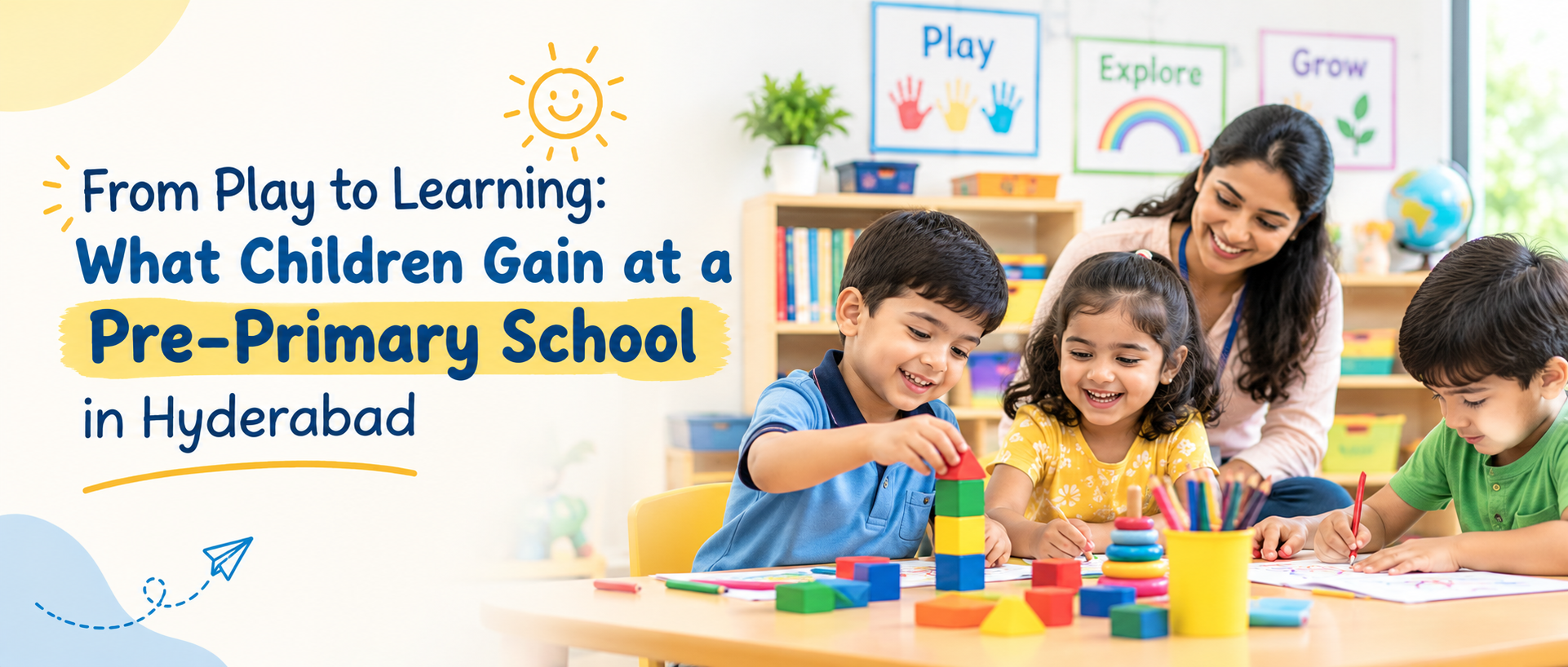
Playing is not just a form of recreation when it comes to younger children. Play is the most elementary way of experimenting with the world around them and comprehending new concepts. Since a toddler is building a tower of blocks, they are not just playing. In the course of playing with the blocks, they learn about weight, size, coordination and problem-solving skills. When children are playing pretend games, they are growing in terms of communication and cooperation skills.
Therefore, a quality pre-primary school in Hyderabad should not consider play and learning as being separate kinds of activities. Instead, day-to-day play experiences should provide children with alternative ways of learning.
What Does Learning Through Play Really Mean?
Learning through play does not imply the absence of guidance for children during playtime.
Educators can strategically design activities that promote the discovery of certain ideas while ensuring children are having fun in the meantime.
An example of such an activity is organising the sorting of colourful items, whereby children will be learning the following: colours, comparisons, patterns, etc.
To children, the activity will seem like playing a game, however, important skills will also be acquired in the process.
Blocks Can Teach More Than You Think
Blocks are simple types of tools available in classes but they can give great need for development for the kid.
For example, when a child is trying to build a tall tower. The first time he was not successful. The child makes another attempt using larger blocks.
In such a way, without any direct instruction an attempt to create a tall tower drives the kid to learn a broader subject: balance, dimensions, structure, and cause and effect.
Moreover, the child learns another important lesson.
Hands-on experience helps children to learn to seek for answers and work through their efforts to solve the problem.
Pretend Play Builds Real-Life Skills
In children's pretend kitchens, they learn that making believe isn't limited to just their imagination.
For example, one child can take the role of the shopkeeper while the other acts like their customer and makes a decision on what to buy, ask questions, change the money they pretend to have, and switch roles.
The above activity supports children learn how to:
- have their first conversations,
- share with others,
- cooperate,
- make their first decisions,
- use their imagination,
- learn how to socialize.
Imaginative role playing is a good way for kids to learn how to deal with different real-life situations.
Stories Turn Listening Into Learning
Storytelling serves as another effective means to mix fun and learning.
During storytelling, a teacher may stop and ask, “What do you think the character will do next?” Pupils can give their predictions, speak about what may happen next, and discuss the character’s feelings.
Such discussions can help children enhance their vocabulary, listening skills, comprehension abilities, imagination, and emotional intelligence.
Even a simple picture book is capable of assisting children in learning new words.
Creative Activities Give Children a Voice
Kids can communicate through other means than verbal ones. Activities like art, music, or crafts can help them express their ideas. When a child is asked to draw their favorite place, there may be plenty of different pictures produced.
Even though one child might draw a park, another a house, and the third one a fantasy world, it does not matter if all the kids have different pictures.
As a result, creative activities give them power to show their individuality, allowing them to make their own choices.
An efficient pre-primary school in Hyderabad also can utilize all these creative activities in order to promote children’s creative thinking while helping them to develop fine motor skills.
Outdoor Play Has Its Own Classroom
There is no need for learning to be limited to classrooms.
Outdoor play offers children a chance to run, jump, balance, see nature, and connect with their environment.
A walk in nature can turn out to be a teaching experience. Kids can see leaf colors, watch bugs, hear birds, and feel textures.
These activities help kids develop their sensory organs and learn to observe while being active.
Learning to Work and Play Together
Little children are still learning the process of communicating with others. Playing games in a group can lead to developing social skills naturally.
Even a simple game where everyone in the group passes a ball teaches kids to wait until it is their turn. Another activity aimed at building a team can make children share the supplies they have and talk about ideas.
It is possible for children to argue sometimes. Guided by adults, children can turn this situation into an opportunity to learn expressing their emotions, hearing other people, and solving problems.
All these experiences make children more self-assured in group situations.
Play Also Builds Emotional Confidence
Sometimes, things don’t go according to plan and the first go is not always successful.
For instance, a child may find it hard to solve a jigsaw puzzle, to create something out of blocks, or to join a team game. It is crucial that children understand that making mistakes is completely natural as it contributes to their learning process.
Once a child achieves something after a number of attempts, this will allow him/her to build a sense of accomplishment.
This is of great importance in early childhood education, since children should be given the chance to fail and start over.
How Kiddles Academy Connects Play With Learning
Children can learn in many ways at Kiddles Academy, rather than just in the classroom.
Children aged between 3 and 6 are encouraged to participate in several different programs that include creative storytelling, arts and crafts, role playing, outdoor exploration, and movement.
Different activities can have different benefits. For example, storytelling can improve language skills, games can enhance cooperation, art can develop creativity and fine motor skills, and outdoor activities can improve observation and physical coordination skills.
At Kiddles Academy, learning is integrated into everyday activities.
When Play Becomes a Foundation for Learning
Play is not just important for what children learn at the moment. The skills developed from play can serve them well as they transition to more formal education.
Children who are prompted to ask questions are likely to develop a curious mindset. Children who practice problem-solving through play may be better equipped to tackle new challenges. Children who learn how to cooperate may have an easier time collaborating with their peers.
This is the reason why early years are so important.
A well-established pre-primary school in Hyderabad creates preconditions for children to learn while playing without feeling that they should be doing something useful all the time.
At Kiddles Academy, preschool education is a process of learning through play, when children develop skills needed for further education.
FAQs
1. How does play help children learn?
Play allows children to explore ideas, solve problems, communicate, make choices, and develop social and physical skills in a natural way.
Comments (0)