



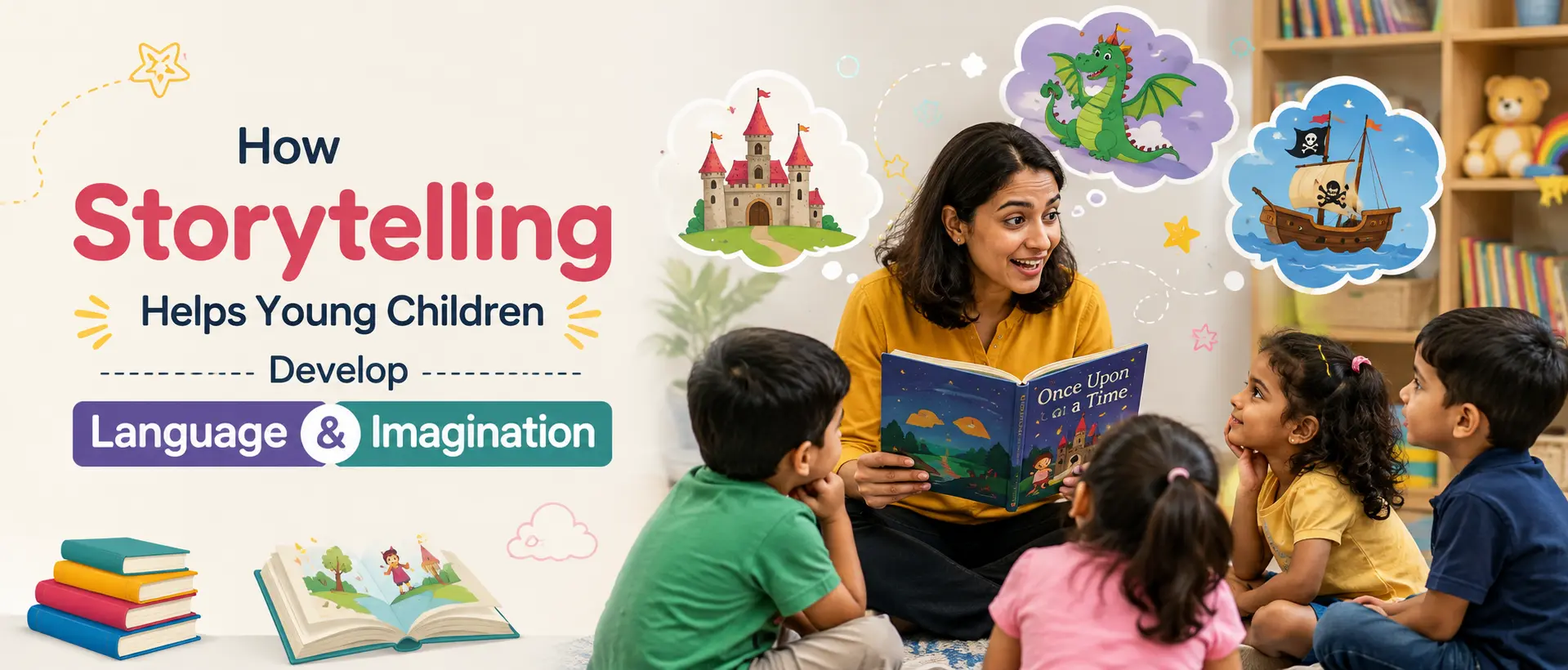
How Storytelling Helps Young Children Develop Language and Imagination
The phrase "Once upon a time..." can work wonders when it comes to aiding children in their learning process.
Stories can play an important role in kids' lives as they help in various ways. Good stories can help children pick up new vocabulary, prompt them to ask questions, teach them how to deal with emotions, and stimulate their imagination.
All this makes storytelling vital for early childhood education. At Kiddles Academy, stories have a place in the learning process and can provide kids with an opportunity to listen, speak, think and communicate their ideas.
If you want to find the best preschool in Chandanagar, do not just look for the simplest criteria like sheets of paper.
A Story Can Introduce New Words Without Feeling Like a Lesson
Young kids acquire language through the repeated hearing of words and using them in a variety of contexts.
For example, with a simple story about a bunny in the rain, rather than using traditional methods of teaching vocabulary such as the words puddle, umbrella, drizzle, and soaked, the teacher can demonstrate the words naturally through the story.
One may afterwards prompt the children by asking:
“What did the rabbit use to escape the rain?”
A child may reply “An umbrella.”
Another child could say, “He jumped into the puddle.”
This means the children experience using new vocabulary without feeling as if they are in a lesson.
Asking Questions Turns Children Into Participants
Hearing in silence is merely one aspect of telling stories. Listening to the story becomes more engaging when the children are encouraged to consider the plot.
A teacher can pause his reading before reaching the end of a given story and ask:
"The little boy has lost his way. What do you think he should do? "
There could be many various answers to the question.
One child might suggest finding an adult for help. Another child might suppose that the boy would follow the road. Yet a third child could represent a fantastic idea where a bird helps the boy.
In most cases, there is no one clear answer to the question.
Such conversations help kids learn to make sentences, express their opinions, and hear what their friends say.
Pictures Give Children Something to Talk About
Picture books are especially beneficial for beginner learners since children are capable of interpreting images even when they are limited in their language abilities.
For instance, a teacher may display an image of an active marketplace and ask the following questions:
- What do you see?
- What do you think the people are doing?
- What do you think is going to happen next?
- How is the little girl feeling?
- Have you ever been to that kind of place?
In return, a child can point at a picture of someone selling fruits and share their colour description or talk about visiting a market with family.
It does not matter whether all answers are grammatically correct. What matters is that kids get communication practice.
Storytelling Gives Imagination Room to Grow
One of the best things about storytelling is that kids do not always take the story as it is.
You can give a child a simple character, such as a young bird, a lost dog, or an inquisitive astronaut, and they would immediately come up with a whole new world around it.
For example, after children have heard a story about a bird looking for a new home, they can be asked to think about the places that the bird might have lived in.
While one child may imagine a tree by the lake, another might think that the bird lives in some colorful city.
Someone else can think that living on the moon is the best option for the bird.
This shows how children’s imagination works based on a simple concept.
Children Can Become the Storytellers
Storytelling becomes even greater when children have the opportunity to create stories on their own.
A teacher can arrange three picture cards in front of students, maybe with pictures of a dog, a bike, and a park, and offer the children to create a story.
The outcome can be funny, surprising, or completely different from the teacher’s expectations.
When making the story, the children are developing the following skills:
- Vocabulary
- Sentence formation
- Sequencing
- Memory
- Creativity
- Communication
The children will also experience the significance of their innovations.
Stories Help Children Understand Feelings
Kids are still learning and discovering how to identify emotions as well as how to express them. The stories can provide these kids with a useful way to experience their emotions through the characters in the story.
When a character in a story is anxious, for example, on the first day of school, the teacher can pose the question: “What makes you think that the character felt anxious?”
The child might say: “Because he does not know anyone.”
The teacher can proceed with asking: “Did you ever feel like that?”
In this way, a simple story can lead to a very meaningful discussion about many emotions like fear, joy, friendship, and bravery.
Thus, kids may learn more about emotions without even realizing that they were taught about them.
Repetition Helps Young Children Learn
Little kids like to hear the same story many times. Adults may ask why a kid wants to hear the same story for the tenth time, but learning through repetition is why kids enjoy hearing stories.
When kids are repeatedly told the same story they can learn more vocabulary, know what comes next, and eventually start to complete sentences by themselves.
A child, who was just listening in the beginning, may say aloud “And then the fox came!” before the teacher turns the page.
This shows how familiarity stimulates speaking and language acquisition.
How Kiddles Academy Uses Storytelling
At Kiddles Academy, storytelling is integrated as a part of the greater early learning process and not just as an isolated activity.
Stories may lead into many different activities such as drawing, role play, conversation, music, craft activities, or a simple discussion in class.
For instance, after they have listened to stories about animals, children may present their favourite animal using craft materials and then talk about it. Alternatively, a story about friendship could lead to a role play activity during which children would perform different characters.
Thus, language is connected to creativity, movement, and social interaction.
Choosing an Environment That Encourages Expression
Childhood is the time when a child starts to find his way or her way in terms of communication with the world. The circumstances of that learning may vary.
The parents in search of the best preschool in Chandanagar, for example, can look for an institution where children learn to ask questions, while at the same time being free to express their thoughts and opinions without fear of being wrong.
Kiddles Academy uses storytelling, among other methods of creating learning experiences.
A story may take only ten minutes to tell, but it usually takes more time to prepare a child for that, such as finding out a new word, developing an idea, or asking a question. All these little things are the beginnings of the learning process.
FAQs
1. How does storytelling help children develop language skills?
Storytelling exposes children to new words, sentence patterns, and conversations. Asking questions about stories also encourages them to speak and explain their ideas.
2. Can storytelling improve a child's imagination?
Yes. Stories give children characters, places, and situations that they can imagine and expand with their own ideas. They can also create different endings or invent their own stories.
3. At what age can children benefit from storytelling?
Children can benefit from storytelling from a very young age. Simple picture books, songs, and short stories can be adapted to suit different stages of development.
4. How can parents encourage storytelling at home?
Parents can read picture books, ask children what they think will happen next, encourage them to describe pictures, or ask them to create their own ending to a familiar story.
5. Why is storytelling useful in preschool education?
Storytelling combines language, imagination, listening, communication, and emotional learning in an enjoyable activity, making it a valuable part of early childhood education.
Comments (0)